
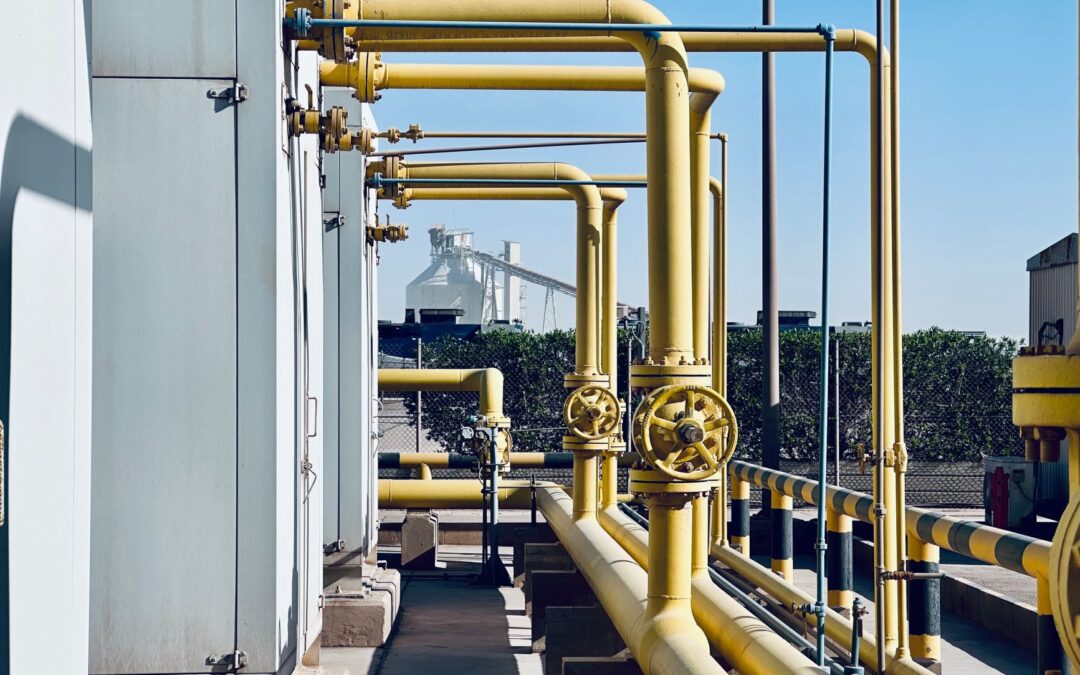
Industrial valves and fittings control the flow, pressure, and direction of fluids and gases across pipelines, refineries, and processing facilities. The right combination depends on three specifics: the process pressure class (from ANSI 150 to 2500), the media temperature, and the sealing requirement. Choosing wrong means leaks, downtime, or safety incidents. This guide explains the valve types, fitting standards, and materials that matter, and how to specify components that survive real service conditions.
What are valves and fittings in industrial applications?
Valves and fittings are the mechanical components that regulate and connect fluid systems. A valve starts, stops, throttles, or reverses flow; a fitting joins pipe segments, changes direction, or adapts diameters. In energy applications — oil, gas, petrochemical, and power generation — these components operate under extreme pressure and temperature, so they are governed by strict standards from bodies like the American Petroleum Institute (API) and ASME.
Core valve categories
- Plug valves — quarter-turn valves ideal for on/off service and frequent operation; excellent for slurries and gas.
- Gate valves — linear-motion valves for full-bore, low-pressure-drop isolation.
- Ball and butterfly valves — quick shutoff and throttling in a compact body.
Core fitting categories
- Flanges (weld-neck, slip-on, blind) for bolted connections.
- Elbows, tees, and reducers for routing and diameter changes.
- Couplings and unions for maintenance access.
Selecting compatible valves and fittings — matched by pressure class, end connection, and material — is the foundation of a leak-free, code-compliant system.
How do you choose the right valves and fittings?
Choose valves and fittings by matching four variables in order: media, pressure, temperature, and end connection. Get these right and the rest of the specification follows.
Step 1 — Define the media
Is the fluid corrosive, abrasive, clean, or dirty? Sour gas with H2S requires NACE MR0175-compliant materials. Abrasive slurries favor plug valves over gate valves.
Step 2 — Set the pressure class
Valves and fittings are rated by ANSI/ASME pressure classes: 150, 300, 600, 900, 1500, and 2500. The class must exceed the maximum operating pressure at the operating temperature — ratings drop as temperature rises.
Step 3 — Confirm temperature limits
Elastomer seals fail above their rated range. Metal-seated valves handle higher temperatures but cost more.
Step 4 — Match the end connection
Flanged, threaded (NPT), socket-weld, or butt-weld ends must match the mating pipe and flange rating. Mixing standards is the most common field error and forces expensive rework.
What are the most common valve types and their trade-offs?
The most common industrial valves are plug, gate, ball, globe, check, and butterfly — each optimized for a specific duty.
Plug valves
Plug valves offer fast quarter-turn operation and reliable bubble-tight shutoff. Pressure-balanced lubricated plug valves reduce operating torque and extend seat life, making them the choice for gas transmission and high-cycle service. Trade-off: higher initial cost than a ball valve of the same size.
Gate valves
Gate valves give an unobstructed full-bore flow path and minimal pressure drop. They are best for isolation duty that stays open or closed, not throttling. Trade-off: slow to operate and prone to seat wear if throttled.
Ball valves
Ball valves combine quick shutoff with a compact footprint and low torque. Trade-off: limited throttling control and potential cavity pressure issues with certain media.
Globe and check valves
Globe valves excel at throttling; check valves prevent backflow automatically. Each solves a narrow problem well and poorly outside it.
How much do industrial valves and fittings cost?
Industrial valves and fittings range from under $50 for a small threaded fitting to over $50,000 for a large high-pressure gear-operated plug valve. Cost is driven by size, pressure class, material, and actuation.
Cost drivers
- Size: Cost rises geometrically with bore diameter — a 12-inch valve can cost 8–10x a 4-inch equivalent.
- Pressure class: A Class 1500 valve may cost double the Class 300 version.
- Material: Carbon steel is the baseline; stainless, duplex, and exotic alloys add 30–300%.
- Actuation: Gear operators, pneumatic, and electric actuators add hundreds to thousands per unit.
For total cost of ownership, factor in maintenance intervals and seat replacement. A lubricated plug valve with a longer service life often beats a cheaper valve that requires frequent rebuilds. Buying from a specialized distributor also matters — proper application support prevents costly mis-specification.
Why do some suppliers rank higher for valves and fittings?
Many suppliers rank well for “valves and fittings” because they publish broad catalogs, but broad coverage rarely means deep application expertise in the energy sector. The distinction that matters to a buyer is not catalog size — it is whether the supplier can match a specific process condition to the correct valve construction, seal material, and actuation.
What deep specialization looks like
- Representing established engineering brands rather than unbranded imports.
- Stocking pressure-balanced lubricated plug valves and matching gear operators as a system, not isolated line items.
- Providing pressure-class, NACE, and end-connection guidance before the order, not after a failure.
Generalist distributors sell across dozens of unrelated categories; a valve specialist maintains inventory and knowledge concentrated in energy-sector flow control. When a plant engineer needs a WKM gate valve or a DYNATORQUE gear operator with the correct output torque, the specialist answers from experience, not a spec sheet lookup. That depth — matching real service conditions to proven equipment — is the advantage a careful buyer should weigh above search ranking alone.
What materials are used for valves and fittings?
The primary materials for valves and fittings are carbon steel, stainless steel, and specialized alloys, each selected for pressure, temperature, and corrosion resistance.
Common body materials
- Carbon steel (ASTM A216 WCB): The workhorse for general oil and gas service up to moderate temperatures.
- Stainless steel (CF8M / 316): Corrosion resistance for chemical and marine environments.
- Duplex and super-duplex: High strength plus corrosion resistance for sour and offshore service.
Seal and trim materials
Elastomer seals (Viton, Nitrile, PTFE) suit lower temperatures and clean media. Metal-to-metal seating handles high temperature and abrasive service. For sour gas, all wetted materials must meet NACE MR0175/ISO 15156 to resist sulfide stress cracking. Matching trim to media is as important as the body material — a correct body with the wrong seat still fails.
What standards govern valves and fittings?
Valves and fittings are governed by API, ASME, and ANSI standards that define dimensions, pressure ratings, testing, and materials. Compliance ensures interchangeability and safety.
Key standards to specify
- API 6D — pipeline valves (ball, gate, plug, check).
- API 600 / 602 — steel gate valves.
- ASME B16.34 — pressure-temperature ratings for valves.
- ASME B16.5 / B16.47 — pipe flanges and flanged fittings.
- NACE MR0175 — sour service materials.
Always confirm the valve carries the correct API monogram or ASME certification and that fittings match the flange standard. Cross-referencing standards early prevents the mismatched-connection problem that stalls installations. For deeper reference on flange dimensions and ratings, ASME publishes the definitive tables that engineers use to verify compatibility before procurement.
Where can you source specialized energy-sector valves?
Specialized energy-sector valves are best sourced from distributors that concentrate on flow control and represent engineered brands, not general MRO catalogs. Energy Valves is one such supplier, distributing plug valves, gate valves, pressure-balanced lubricated plug valves, and gear operators, and representing brands including KF, Galli & Cassina, and WKM. You can review the full range on their line sheet and product catalog.
What to expect from a specialist
- Application matching by pressure class, media, and temperature.
- Matched valve-and-operator systems, including DYNATORQUE gear operators sized to the correct output torque.
- Inventory concentrated in energy-sector flow control rather than spread across unrelated categories.
When sourcing, request the material test reports, pressure-test certificates, and the applicable API or ASME documentation before purchase. A specialist supplier provides these as standard and can advise when a standard configuration will not meet the service condition — which, in high-pressure energy applications, is exactly where the value of specialization shows.
Frequently Asked Questions
What is Industrial Valves and Fittings: A Complete Buyer's Guide?
A complete guide to industrial valves and fittings: types, pressure ratings, materials, and how to choose the right components for energy applications. Who is Industrial Valves and Fittings: A Complete Buyer's Guide for? || This page is intended for users searching for practical, reliable information.