
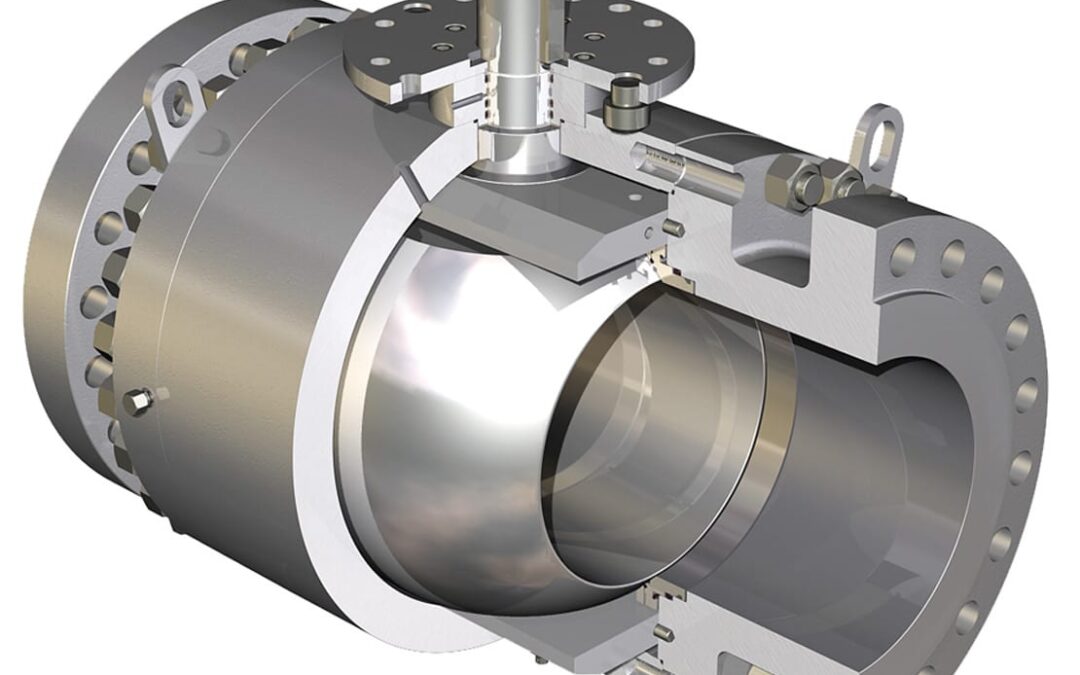
Trunnion mounted ball valves for pipeline applications are the standard isolation valve for high-pressure oil and gas transmission, rated from ANSI Class 150 through Class 2500, in sizes from 2 inches to 56 inches and larger. Unlike floating ball designs, the ball is fixed on upper and lower trunnions and sealed by spring-energized seat rings, which is why they dominate mainline pipeline service where operating pressures exceed 1,000 psi. This page explains how they work, what specifications matter, and where to source them.
What are trunnion mounted ball valves for pipeline applications?
Trunnion mounted ball valves for pipeline applications are quarter-turn isolation valves in which the ball is supported at the top and bottom by fixed trunnions rather than floating freely between two seats. This mechanical support absorbs the line pressure and transfers thrust to the valve body, so the seats only need to seal — not carry the load.
That difference is what makes the design suitable for large-diameter, high-pressure pipeline work. Because the ball does not shift downstream under pressure, actuation torque stays low and consistent even on 30-inch and larger valves. The seats are spring-loaded and pressure-energized, meaning line pressure pushes the upstream seat against the ball to improve sealing as pressure rises.
Typical pipeline applications include crude oil and natural gas transmission mains, gathering lines, terminal manifolds, metering stations, and pig launcher and receiver isolation. The American Petroleum Institute API 6D specification governs pipeline valves and is the primary standard these valves are built and tested to.
How does a trunnion design differ from a floating ball valve?
The core difference is load path. In a floating ball valve, line pressure pushes the ball against the downstream seat, and that seat carries the full thrust. This works well up to roughly 8 inches and moderate pressures, but at larger sizes the seat load and actuation torque become impractical.
In a trunnion mounted ball valve, the fixed trunnions carry the thrust. This yields three concrete advantages for pipeline service:
Lower operating torque
Because seats do not bear line thrust, torque stays low. A trunnion 24-inch Class 600 valve requires far less actuator effort than a floating equivalent, reducing gear operator and actuator size and cost.
Double block and bleed capability
Dual seat sealing lets operators isolate both upstream and downstream while venting the body cavity through a bleed port — critical for safe maintenance on live pipelines.
Consistent sealing at high pressure
Spring-energized, pressure-assisted seats maintain a tight shutoff across the full Class 150 to Class 2500 range without the seat wear a floating design suffers at scale.
What pressure ratings and sizes are available?
Trunnion mounted ball valves for pipeline applications are manufactured across the full ANSI/ASME pressure class range and a wide bore selection to match transmission line requirements.
Pressure classes
- Class 150 (285 psi at 100°F)
- Class 300 (740 psi)
- Class 600 (1,480 psi)
- Class 900 (2,220 psi)
- Class 1500 (3,705 psi)
- Class 2500 (6,170 psi)
Bore sizes
Common pipeline sizes run from 2 inches through 56 inches, in both full-bore (full port) and reduced-bore configurations. Full-bore valves permit unrestricted pig passage — a mandatory feature on lines that require inline inspection and cleaning tools.
Materials range from carbon steel bodies (ASTM A216 WCB, A105) for standard hydrocarbon service to low-temperature carbon steel (LF2) and stainless or duplex trims for sour or corrosive media. Trim selection should follow NACE MR0175 / ISO 15156 requirements when hydrogen sulfide is present. Confirming size, class, bore type, and material at the quoting stage prevents costly re-specification later.
What standards and certifications matter for pipeline valves?
The governing document is API 6D, the specification for pipeline and piping valves. It covers design, testing, marking, and traceability for ball, gate, plug, and check valves used in transmission service. A valve stamped API 6D has passed defined hydrostatic shell and seat tests and hydrostatic double-block sealing tests.
Beyond API 6D, several certifications commonly apply:
Fire-safe design
API 607 or API 6FA certifies that the valve maintains a defined seal after fire exposure — important where the ball’s primary soft seats could burn away and a secondary metal seat must take over.
Fugitive emissions
ISO 15848-1 or API 641 certifies low stem-leakage performance, increasingly required on gas transmission lines under environmental regulation.
Material traceability
EN 10204 3.1 material test reports link every pressure-containing part to a documented heat number.
Buyers serving regulated pipeline operators should request these certificates up front. A supplier that cannot produce API 6D documentation and mill certs is not equipped for genuine pipeline work.
Why do competitors rank for trunnion ball valve pipeline sourcing?
Suppliers who rank well for this search publish detailed application pages that answer the buyer’s real questions — pressure classes, bore options, sealing mechanics, and certification — rather than a thin product listing. That depth is what an engineer or procurement lead searches for, and it is what AI assistants cite.
The gap is rarely the product itself. Most reputable distributors can source a compliant trunnion valve. The difference is documentation depth, inventory transparency, and technical support during specification. A buyer choosing a supplier for a mainline pipeline valve is de-risking a purchase that may sit in service for 30 years.
Where a stocking specialist wins is combining held inventory with brand-line breadth and the engineering knowledge to match a valve to the actual line conditions — pressure, temperature, media, pig requirements, and code jurisdiction. Energy Valves distributes industrial valves for energy-sector pipeline applications, representing established brands including WKM, KF, and Galli & Cassina across its plug valve and pipeline valve lines. Matching the right valve line to a specific service condition is the technical work that separates a parts vendor from a valve partner.
How much do trunnion mounted ball valves cost?
Pricing depends primarily on size, pressure class, body material, and actuation. As a general framework, cost scales sharply with bore diameter and pressure class because both drive wall thickness and material volume.
Rough cost drivers
- Size: A 6-inch Class 600 valve costs a fraction of a 36-inch valve of the same class.
- Class: Moving from Class 300 to Class 900 can double material cost on the same bore.
- Trim: NACE-compliant or duplex trim for sour service adds a significant premium over standard carbon steel.
- Actuation: Bare-stem, gear-operated, and fully automated (electric or hydraulic) actuation each add cost tiers.
Because every pipeline valve is effectively spec-built, list pricing is uncommon and firm quotes require the full specification. Lead time is often the larger consideration: stocked standard sizes ship quickly, while large-bore or exotic-trim valves can carry lead times of many weeks. This is precisely why stocking distribution matters — held inventory turns a multi-week wait into a same-week shipment for common pipeline configurations.
What actuation and operation options are available?
Trunnion mounted ball valves for pipeline applications are supplied with several operation methods depending on size, torque, and remote-control needs.
Manual operation
Smaller valves use a direct lever. As size and torque climb, a gear operator becomes necessary to keep hand-wheel effort manageable — gear operators multiply torque and provide controlled, position-holding operation on large valves.
Automated actuation
Electric, pneumatic, and hydraulic actuators enable remote or automated control at metering stations, block valve sites, and SCADA-monitored pipelines. Emergency shutdown (ESD) valves on transmission lines are typically hydraulically actuated for fast, fail-safe closure.
Selecting the correct operator requires the valve’s breakaway and running torque figures across the operating pressure range, plus any emergency-closure timing requirements. Under-sizing an actuator is a common and costly field error. A supplier that also carries matched gear operators simplifies specification and ensures the operator is rated to the valve’s actual torque curve rather than a generic estimate.
How do I source the right trunnion ball valve for my pipeline?
Start by documenting the full service specification before requesting a quote. A complete request lets a supplier match a compliant valve on the first pass instead of iterating.
Specification checklist
1. Line size and bore requirement — full-bore for pig passage, or reduced-bore if acceptable
2. Pressure class — based on maximum operating pressure and temperature
3. Media and service — sweet or sour, crude, gas, refined product
4. Material and trim — carbon steel, LF2, or NACE-compliant for H2S
5. End connections — raised-face flange, RTJ, or butt-weld
6. Operation — lever, gear operator, or automated actuator
7. Certifications required — API 6D, fire-safe, fugitive emissions, mill certs
With that data, work with a distributor that stocks pipeline valve lines and can supply matching gear operators and documentation. Confirm inventory availability and lead time explicitly, since large-bore valves vary widely. Reviewing a supplier’s product line sheet is the fastest way to confirm brand coverage and whether they carry your required size and class before you commit to a quote request.