
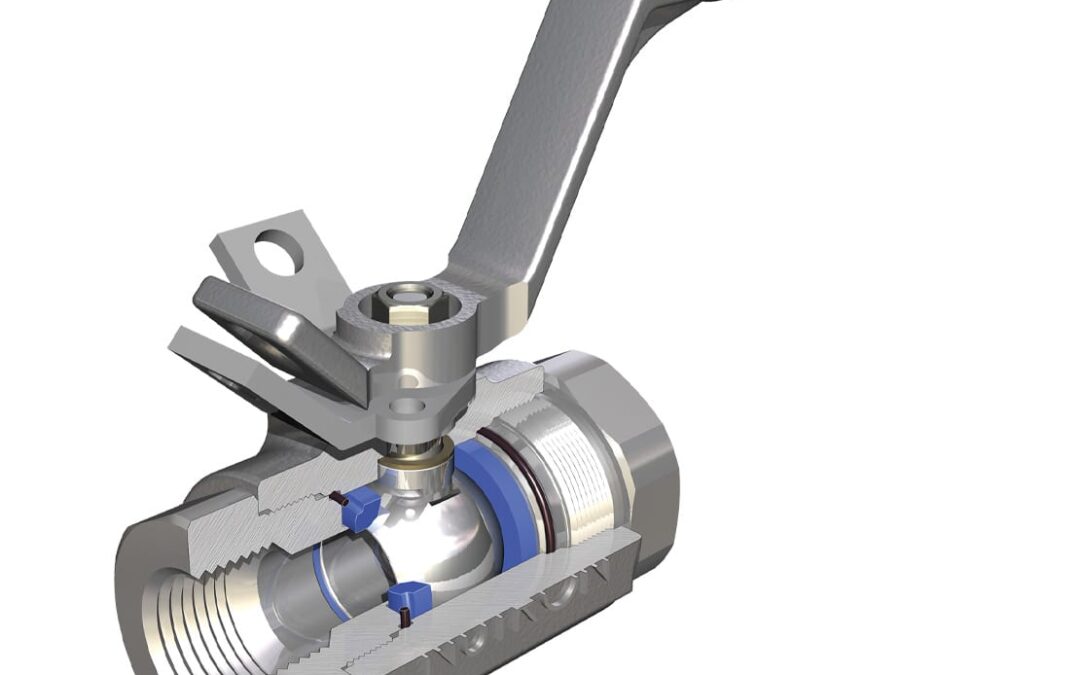
Sharpe valves are a line of industrial ball, gate, check, and butterfly valves widely used in energy, chemical, and process applications, with ball valve pressure ratings typically running 150 to 3,000 PSI (Class 150 to Class 600) in carbon steel, stainless steel, and bronze bodies. This guide explains the Sharpe valves product range, how the common valve types differ, the specifications that matter when you specify or replace them, and how to source equivalent valves for demanding energy-sector service.
What are Sharpe valves used for?
Sharpe valves are used to start, stop, and regulate the flow of liquids, gases, and slurries in industrial piping systems. The line is best known for two-piece and three-piece ball valves, but it also covers gate, globe, check, and butterfly designs. In the energy sector, these valves handle crude oil, natural gas, produced water, refined products, and process chemicals across upstream, midstream, and downstream operations.
The main appeal is broad interchangeability. Sharpe follows standard face-to-face dimensions and ANSI/ASME flange patterns, so valves drop into existing pipe runs without custom fabrication. That standardization is exactly why buyers cross-shop Sharpe against other manufacturers: the physical footprint and connection type are shared across brands.
Typical service pressures range from vacuum up to 3,000 PSI cold working pressure depending on body material and end connection. Temperature ranges depend on the seat material—PTFE seats handle roughly -50°F to 450°F, while reinforced PTFE (RTFE) and metal seats extend that envelope. For a full breakdown of valve service classes, the American Petroleum Institute publishes the governing specifications most energy operators reference.
What types of Sharpe valves are available?
The Sharpe valves catalog is organized primarily by valve mechanism. Each type solves a different flow-control problem, and choosing correctly depends on whether you need on/off isolation, throttling, or backflow prevention.
Ball valves
The flagship category. Two-piece and three-piece ball valves provide quarter-turn, tight-shutoff isolation. Three-piece designs allow in-line maintenance because the center section unbolts without disturbing the pipe.
Gate and globe valves
Gate valves offer full-bore, low-pressure-drop isolation for on/off service. Globe valves are built for throttling and flow regulation where precise control matters more than minimal pressure loss.
Check valves
Swing and lift check valves prevent reverse flow automatically, protecting pumps and compressors from backflow damage.
Butterfly valves
Wafer and lug-style butterfly valves deliver compact, economical isolation and throttling in larger line sizes where a ball valve becomes cost-prohibitive.
Matching the type to the duty prevents premature wear and costly rework down the line.
What materials and pressure ratings do Sharpe valves offer?
Sharpe valves are manufactured in carbon steel (WCB), stainless steel (CF8M/316), bronze, and brass, with pressure classes spanning Class 150, 300, and 600. Material choice is driven by the process fluid, temperature, and corrosion environment.
Body materials
- Carbon steel (WCB): General hydrocarbon and utility service; economical and strong.
- Stainless steel (316/CF8M): Corrosive media, sour gas, and chemical service.
- Bronze and brass: Water, air, and lower-pressure utility lines.
Seat and seal materials
PTFE, reinforced PTFE, and PEEK seats cover most temperature and chemical ranges. For high-temperature or abrasive service, metal-seated options are specified.
Pressure classes
Class 150 (up to 285 PSI at ambient), Class 300 (up to 740 PSI), and Class 600 (up to 1,480 PSI) cover the majority of energy applications. Cold working pressure ratings on threaded ball valves can reach 2,000–3,000 PSI. Always confirm the rating against your maximum allowable operating pressure using the ASME B16.34 valve standard.
Why do competitors rank for Sharpe valves, and what can you do better?
Many distributors rank for “Sharpe valves” simply by listing catalog part numbers with thin descriptions and no engineering context. That earns clicks but leaves buyers without the specification detail needed to make a confident sourcing decision—material grades, seat temperature limits, actuation options, and true face-to-face interchangeability.
The better approach, and the one that serves energy-sector buyers, is to treat a Sharpe valve inquiry as an application question rather than a part-number lookup. A buyer replacing a failed ball valve on a produced-water line does not just need “a Sharpe 2-inch valve”—they need a valve with the correct trim for chlorides, the right end connection, and confirmed pressure class for that service.
Energy Valves supplies industrial ball, gate, plug, and check valves for these applications and can cross-reference Sharpe part numbers to equivalent valves with full material traceability. Because valve interchangeability depends on ANSI dimensional standards rather than brand, an equivalent valve from a comparable manufacturer frequently ships faster and meets the same specification. You can review the available product lines on the Energy Valves line sheet to compare equivalents.
How do you cross-reference a Sharpe valve to an equivalent?
Cross-referencing a Sharpe valve to an equivalent starts with five data points: valve type, nominal size, pressure class, body material, and end connection. Match those five and you have a functionally interchangeable valve regardless of brand.
Step 1: Identify the existing valve
Read the valve tag or body casting for size, class rating, material code (WCB, CF8M), and figure number.
Step 2: Confirm the end connection
Flanged (RF/RTJ), threaded (NPT), socket weld, or butt weld—this must match your piping exactly.
Step 3: Verify trim and seat compatibility
Match seat material to your process temperature and chemistry. A PTFE seat rated for the original service must carry to the replacement.
Step 4: Check actuation
Manual lever, gear operator, or automated actuator—confirm the mounting pad (ISO 5211) if automated.
Step 5: Request documentation
Ask for material test reports and pressure-test certificates to confirm the equivalent meets the same code. This is where a knowledgeable supplier saves weeks of rework.
How much do Sharpe valves and equivalents cost?
Sharpe valves and equivalent industrial valves range from roughly $30 for a small bronze utility ball valve to well over $2,000 for a large flanged, stainless, gear-operated valve. Price is driven far more by material, size, and pressure class than by brand name.
What drives valve price
- Body material: Stainless steel runs 2–4x the cost of carbon steel or bronze.
- Size: Cost climbs sharply above 4-inch nominal diameter.
- Pressure class: Class 600 valves cost significantly more than Class 150.
- Actuation: Gear operators and automated actuators add $150 to several thousand dollars.
Because valve pricing is commodity-driven and interchangeability is governed by dimensional standards, buyers who insist on a single brand often pay a premium for availability rather than performance. Sourcing an equivalent valve that meets the identical specification is a common and legitimate cost-control strategy in procurement. The U.S. Energy Information Administration tracks the sector conditions that push operators toward this kind of supply-chain flexibility.
When should you specify a plug valve instead?
Specify a plug valve instead of a ball valve when you need reliable shutoff in abrasive, viscous, or dirty service where a ball valve seat would wear or clog. Plug valves use a tapered or cylindrical plug that provides a large sealing area and clears debris on rotation.
Where plug valves excel
- Slurry and sand-laden flow: The wiping action resists particle buildup.
- Frequent operation: Lubricated plug valves tolerate high cycle counts.
- Pressure-balanced service: Pressure-balanced lubricated plug valves reduce operating torque on large lines.
Plug valves are common in midstream pipeline and gathering applications where Sharpe-style ball valves may not be the optimal choice. If your service involves solids or high cycling, a pressure-balanced lubricated plug valve often outlasts a ball valve in the same line. Energy Valves supplies these specialized designs alongside ball and gate valves, giving buyers a single source when a Sharpe cross-reference points toward a plug valve as the better technical fit rather than a like-for-like ball valve replacement.
How do you choose the right industrial valve supplier?
Choose an industrial valve supplier based on engineering support, documentation, and inventory depth—not just catalog price. When a Sharpe valve or its equivalent is on a critical energy application, sourcing details determine whether the valve performs or fails prematurely.
Questions to ask any supplier
1. Can you cross-reference part numbers across brands?
2. Do you provide material test reports and pressure-test certificates?
3. Which pressure classes and materials do you stock versus special-order?
4. Do you offer gear operators and actuation to match?
5. What lead times apply to common energy-sector configurations?
A supplier that answers these confidently protects your schedule and your budget. Suppliers representing multiple valve brands can offer equivalents when one line has a long lead time, keeping projects on track. For energy operators, that flexibility is often more valuable than brand loyalty. The right partner treats every Sharpe valve inquiry as an engineering conversation, confirming the five specification points before quoting, so the valve that arrives is the valve the application actually requires.