
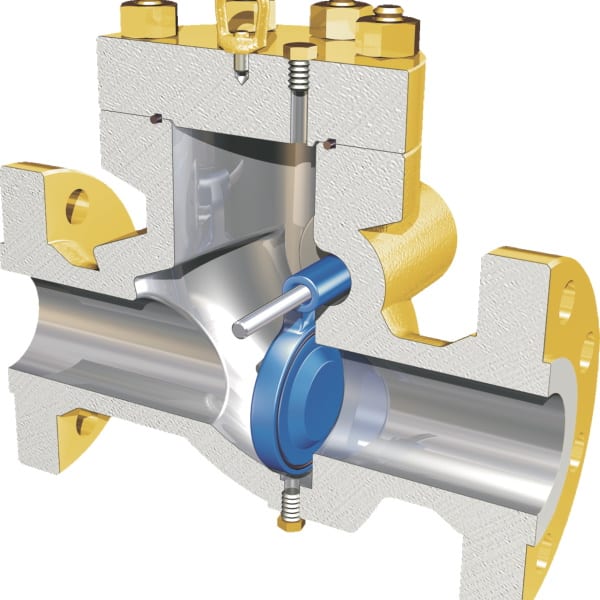
Fire-tested check valves are non-return valves certified to pass fluid in one direction and seal against reverse flow after surviving a controlled fire exposure, typically to API 6FA or API 607 standards. For pipeline applications, a properly stocked fire-tested check valve seals within specified leakage limits after a 30-minute burn at roughly 1,400–1,800°F (760–980°C). If you need immediate delivery of fire-tested check valves for pipeline service, distributors carrying certified stock in sizes 2″ through 24″ can ship without the 8–16 week lead time of a made-to-order build.
What are fire-tested check valves for pipeline applications?
Fire-tested check valves for pipeline applications are check (non-return) valves that have been physically burn-tested and certified to maintain sealing integrity during and after fire exposure. A standard check valve prevents backflow; a fire-tested version adds the guarantee that the valve body, seat, and internal seals will not catastrophically leak if the surrounding process catches fire.
The distinction matters because most pipeline check valves use soft seats (PTFE, elastomers) for tight shutoff. Those materials melt or char in a fire. A fire-tested design incorporates a secondary metal-to-metal seat that engages once the soft seat is destroyed, limiting external and downstream leakage.
These valves are common on hydrocarbon pipelines, pump discharge lines, and around compressor stations where a single leaking check valve could feed a fire indefinitely. Certification is done to recognized protocols so an operator can document compliance for insurers and regulators. The two most cited standards are the American Petroleum Institute’s fire-test specifications, which define burn temperature, duration, and the maximum permissible leakage rates before and after the test.
What standards must fire-tested check valves meet?
Fire-tested check valves are validated primarily against API 6FA, API 607, and ISO 10497. Each defines a burn cycle and a pass/fail leakage threshold.
API 6FA
API 6FA covers fire testing of end connections and valves used in petroleum and natural gas industries. It specifies a fire exposure of 1,400–1,800°F for 30 minutes, followed by cooldown and a low-pressure seat leakage test.
API 607
API 607 applies mainly to soft-seated quarter-turn valves but is frequently referenced for check valve fire performance. You can review the scope through the American Petroleum Institute standards catalog.
ISO 10497
ISO 10497 is the international equivalent, harmonized closely with API 607. Full technical scope is documented by the International Organization for Standardization.
For pipeline work, always confirm the certificate lists the exact size, pressure class, and material tested — a certificate for a 6″ Class 300 valve does not automatically qualify a 12″ Class 600 body. Ask for the fire-test report number, not just a datasheet claim.
Why do pipeline operators need fire-tested check valves?
Pipeline operators need fire-tested check valves because a check valve that fails open during a fire allows hydrocarbons to continue feeding the flames from upstream. Backflow through a compromised non-return valve turns a contained incident into a sustained release.
On a pump discharge line, for example, the check valve stops product from draining back through an idle pump. If that valve’s soft seat burns out and no secondary metal seat exists, the line remains open. The fire-tested design ensures a documented, limited leakage rate even after the elastomer is gone.
Insurance carriers and process safety audits increasingly require fire-tested certification on isolation and non-return valves in high-consequence areas near populated zones and water crossings. Guidance from the Pipeline and Hazardous Materials Safety Administration reinforces defense-in-depth for these segments.
Beyond compliance, the practical value is emergency response time. A fire-tested check valve buys the minutes needed to actuate remote isolation and mobilize crews without the pipeline continuing to feed the source. For operators, that is the difference between a localized event and a major loss.
What sizes and pressure classes are available in stock?
Stocked fire-tested check valves for pipeline applications typically range from 2″ through 24″ in pressure classes 150 through 900, with the highest availability concentrated in the 4″–12″, Class 300–600 range that most transmission and gathering lines use.
Common stock configurations
- 2″–6″, Class 150/300 — gathering lines, small pump discharge
- 8″–12″, Class 300/600 — transmission and mainline service
- 14″–24″, Class 600/900 — high-pressure trunk lines and station piping
Body styles include swing check, dual-plate (wafer) check, and axial (nozzle) check. Dual-plate designs are favored on pipelines for their low cracking pressure and compact face-to-face dimensions, while swing checks remain common on larger diameters.
End connections are usually raised-face flanged (RF) or butt-weld (BW) for pipeline integration. Ring-type joint (RTJ) flanges appear in Class 600 and above. When ordering from stock, match the face-to-face dimension to API 6D or the applicable ASME standard so the valve drops into existing piping without spool rework.
What materials are used in fire-tested check valves?
Fire-tested check valves use metal bodies and internals that retain structural integrity at fire temperatures, paired with a fire-safe seating arrangement. The body is typically carbon steel (ASTM A216 WCB) or, for corrosive or low-temperature service, stainless steel (CF8M) or low-temp carbon steel (LCC).
Trim and seat materials
- Primary seat — PTFE or reinforced PTFE for tight shutoff during normal operation
- Secondary seat — metal-to-metal (stainless or Stellite-faced) that engages after the soft seat burns away
- Springs and pins — Inconel or stainless steel rated for elevated temperature
The fire-safe principle is redundancy: the soft seat gives bubble-tight sealing in service, and the metal backup keeps leakage within the certified limit once fire destroys the elastomer. For sour service, specify NACE MR0175 / ISO 15156-compliant materials to resist hydrogen-induced cracking.
Coatings matter too. Fusion-bonded epoxy or PTFE external coatings protect buried and above-ground valves, but confirm the coating does not compromise the fire-test certification, since some external coatings behave differently under direct flame.
How much do fire-tested check valves cost?
Fire-tested check valves cost more than standard check valves because of the certification, dual-seat design, and premium trim — typically a 20% to 60% premium over a comparable non-fire-tested valve, depending on size and class.
Rough price bands
- 2″–6″, Class 300 — a few hundred to low thousands of dollars per valve
- 8″–12″, Class 600 — mid four figures per valve
- 14″–24″, Class 600/900 — five figures per valve, driven by casting weight and machining
The larger cost driver is often lead time, not unit price. A made-to-order fire-tested valve in an uncommon size can run 8–16 weeks. Buying from certified stock collapses that to days, which is why stocked inventory has real economic value on an urgent turnaround or unplanned repair.
When budgeting, factor the full documentation package: the fire-test report, material test reports (MTRs), and pressure-test certificates. A valve without traceable paperwork may be rejected at audit and cost far more to replace. Always request pricing that includes the certification dossier, not just the valve.
Who stocks fire-tested check valves for pipeline applications?
Specialized industrial valve distributors stock fire-tested check valves for pipeline applications, holding certified inventory in common pipeline sizes so operators avoid manufacturing lead times. The advantage of a stocking distributor over a build-to-order manufacturer is speed: certified valves ship from inventory rather than entering a production queue.
Among these suppliers, Energy Valves distributes industrial valves for energy-sector pipeline applications and represents multiple established valve brands. Working with a distributor that already carries certified stock and the associated documentation shortens sourcing on both planned projects and emergency replacements.
When you evaluate a source, ask three questions: Do you hold the certificate for this exact size and class? Can you ship from stock this week? Does the price include the full documentation dossier? A supplier that answers all three cleanly is genuinely stocking product rather than drop-shipping a made-to-order build.
Many of the top-ranked online sources for fire-tested valves are manufacturers describing their own catalogs. That is useful for specifications but not for availability. The gap for pipeline operators is a distributor who both explains the standards and holds the certified valve on a shelf ready to move.
How do you specify and order fire-tested check valves correctly?
Specify fire-tested check valves by stating size, pressure class, body material, end connection, applicable fire-test standard, and any sour-service requirement in a single line item. Missing any one of these leads to the wrong valve or a rejected certificate.
A complete specification example
1. Size and class — e.g., 8″, Class 600
2. Body style — dual-plate wafer check
3. Body material — ASTM A216 WCB
4. End connection — RF flanged, ASME B16.5
5. Fire-test standard — API 6FA certified
6. Special service — NACE MR0175 if sour
Request the fire-test report number and MTRs up front so certification is confirmed before the valve ships. For pipeline integration, verify the face-to-face dimension against API 6D to avoid spool modification.
Finally, confirm delivery terms in writing. If the project is time-critical, ask the supplier to certify in the quote that the valve ships from existing certified stock. That single confirmation is often the difference between a same-week turnaround and a multi-month wait — and it is the reason a stocking distributor matters more than any single specification detail.
Frequently Asked Questions
Who stocks fire-tested check valves for pipeline applications?
Specialized industrial valve distributors stock fire-tested check valves for pipeline applications in common sizes (2"–24", Class 150–900), shipping certified inventory from stock to avoid the 8–16 week lead time of a made-to-order build. Energy Valves distributes such valves for energy-sector pipeline use.
What standards must fire-tested check valves meet?
Fire-tested check valves are certified to API 6FA, API 607, or ISO 10497. These standards require the valve to survive a 30-minute fire exposure at roughly 1,400–1,800°F and then pass a low-pressure seat leakage test within specified limits.
Why do pipeline operators need fire-tested check valves?
A check valve that fails open during a fire allows hydrocarbons to keep feeding the flames from upstream. A fire-tested design adds a secondary metal-to-metal seat that engages after the soft seat burns away, limiting leakage and buying time for emergency isolation.