
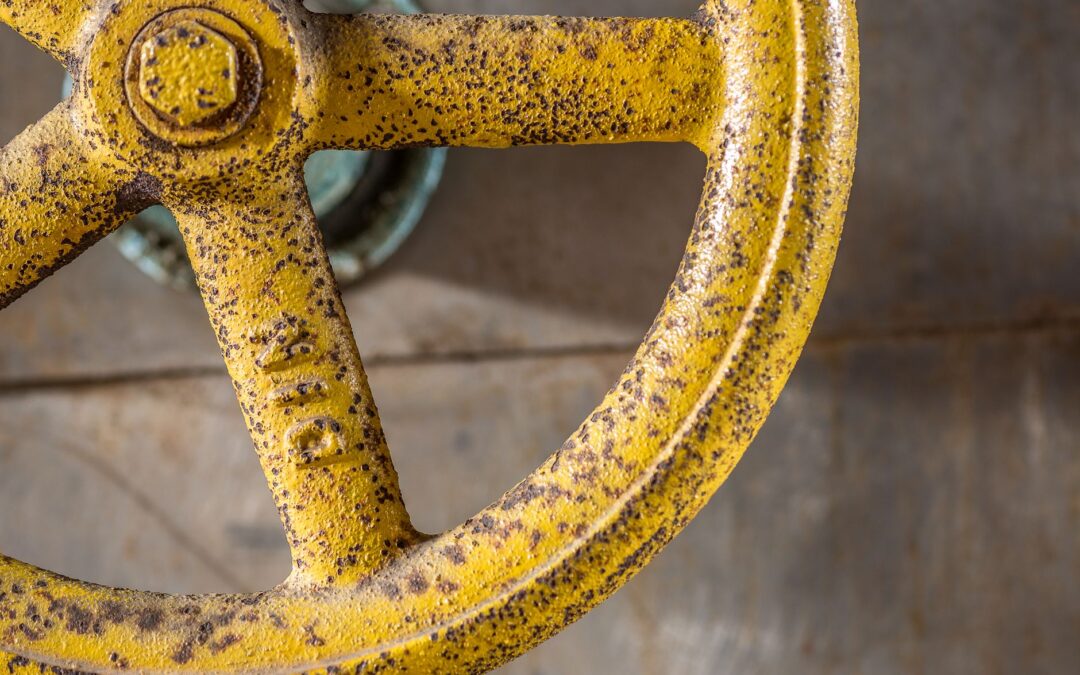
An OS&Y valve (outside screw and yoke) is a rising-stem gate valve whose threaded stem moves up and down outside the valve body, giving a clear visual indication of whether the valve is open or closed. The farther the stem protrudes above the handwheel, the more fully the valve is open. This visible-stem design is why OS&Y valves are the standard isolation valve for fire protection systems, water mains and other services where crews must confirm valve position from a distance.
This page is the working reference for buyers sourcing an OS&Y valve: how the mechanism works, where it is specified, how it compares to non-rising-stem gate valves, how to size and seat-check it, and how to request a quote through a wholesale supply channel.
What is an OS&Y valve and how does it work?
An OS&Y valve is a gate valve in which the stem threads are located outside the valve body, inside a yoke mounted above the bonnet. When you turn the handwheel, the stem itself rises or lowers, lifting or dropping a flat gate across the flow path.
Because the threads never contact the process fluid, the OS&Y design protects the stem threads from corrosive media, scale and debris — one reason it outlasts inside-screw designs in dirty-water and fire-main service. The position of the stem is also the position indicator: stem up means open, stem down means closed. There is no guessing.
Core parts of an OS&Y gate valve
- Gate — the flat wedge that seals across the bore
- Rising stem — threaded shaft that travels vertically
- Yoke — the frame outside the body that captures the stem nut
- Handwheel — rotates the stem nut to raise or lower the stem
- Body and bonnet — the pressure-containing shell
OS&Y valves are typically specified for full-open or full-closed isolation duty, not throttling. A partially open gate causes turbulence and seat wear, so these valves are opened and closed fully.
Where are OS&Y valves used?
An OS&Y valve is most commonly found anywhere an operator or inspector must verify valve position by sight. The visible rising stem makes it the default isolation valve in fire sprinkler and standpipe systems, where NFPA 13 sprinkler standards require that control valves indicate whether they are open or shut.
Common applications
- Fire protection — sprinkler risers, standpipes, fire-pump suction and discharge isolation
- Municipal and plant water mains — isolation on potable and raw water lines
- Process utility lines — cooling water, service water and similar full-bore isolation
- Pump and equipment isolation — block valves upstream and downstream of critical equipment
Because the stem position is unambiguous, OS&Y valves are favored wherever fast, correct lockout verification matters. In fire service they are frequently paired with a tamper switch so a building management system is alerted if someone closes the valve. Where space above the valve is tight, a non-rising-stem (NRS) gate valve may be substituted — which is the first trade-off to understand.
OS&Y vs non-rising-stem gate valves: which should you choose?
Choose an OS&Y valve when position must be visible and vertical clearance is available; choose a non-rising-stem valve when overhead or buried space is limited. Both are gate valves and both give tight shutoff, but they signal their position differently.
OS&Y (rising stem) advantages
- Stem position is visible from a distance
- Threads stay out of the process fluid, resisting corrosion and fouling
- Easy to lubricate and inspect the stem
- Preferred and often code-required for fire protection
Non-rising-stem advantages
- Compact — the stem does not travel upward, ideal for buried service or tight headroom
- Fewer exposed moving parts in dirty environments
The practical rule: aboveground fire and plant isolation usually calls for OS&Y; buried water mains often use NRS with a position indicator post. If you are unsure which the drawing or inspector expects, confirm before ordering, since the two are not freely interchangeable on an inspected system.
How do you size and select an OS&Y valve?
Select an OS&Y valve by matching four things: nominal size, pressure class, body/trim materials, and end connections. Getting any one wrong means a valve that will not seat, fit or pass inspection.
Selection checklist
- Size — nominal pipe size (NPS), commonly 2″ through 12″ and larger for mains
- Pressure class — 125, 150, 175, 200, 250 or 300 psi water ratings are common for OS&Y gate valves; verify against system working pressure
- End connection — flanged, grooved (for fire service) or threaded
- Body material — cast iron, ductile iron or cast steel depending on service
- Seat and trim — bronze-mounted or iron seats; resilient-wedge options for water service
- Approvals — fire-service valves may require UL Listing or FM Approval
For fire protection, always confirm the valve carries the listing your authority having jurisdiction requires; standards references are published by UL and insurers. For dimensional and pressure-temperature standards on gate valves, the American Petroleum Institute and ASME publish the governing specifications your spec sheet will cite.
What does an OS&Y valve cost?
OS&Y valve pricing varies widely by size, pressure class, material and approval, so a specific price belongs on a quote rather than an article. As a general orientation, a small flanged iron-body OS&Y gate valve sits at the low end, while large-diameter, cast-steel or UL/FM-approved fire-service valves cost substantially more.
What drives the price
- Size — cost rises steeply with diameter
- Material — cast steel and stainless trim cost more than cast or ductile iron
- Approvals — UL Listed / FM Approved fire valves carry a premium
- End connections — grooved and specialty ends can change the price
- Quantity and tier — reseller and volume pricing differ from single-unit retail
Because availability and lead time move with the market, the reliable way to price an OS&Y valve for a project is to send the size, class, material and quantity to a supplier and request a current quote. Resellers buying for inventory should also confirm pricing tiers and stock before committing to an end-customer bid.
How do you maintain and inspect an OS&Y valve?
Maintain an OS&Y valve by keeping the exposed stem clean and lubricated and by exercising the valve on a schedule so the gate does not seize. The visible stem makes routine inspection simple: confirm the valve is in its intended position and that the stem threads are clean and greased.
Routine maintenance steps
1. Confirm valve position matches the system requirement (open for most fire control valves)
2. Wipe and re-lubricate the exposed stem threads
3. Exercise the valve fully open and fully closed periodically to prevent seizing
4. Check packing at the bonnet for leaks and re-tighten or replace as needed
5. For fire service, verify the tamper switch and any supervision signal
Fire protection control valves are typically inspected on the schedule set by your governing fire code and insurer. Keeping a spare OS&Y valve of the same size and class on hand shortens downtime if a valve fails an inspection, which is another reason resellers stock common sizes.
Why does choosing the right OS&Y valve supplier matter?
The right OS&Y valve from the wrong supplier still fails you if the size, class or approval is wrong, or if the valve is not in stock when the job needs it. For resellers and distributors, supply reliability is as important as the valve itself: a confirmed-in-stock valve with the correct pressure class and approvals keeps downstream customers on schedule.
That is where sourcing through an established wholesale channel pays off. A good supply partner confirms the exact specification, verifies availability before you commit to a customer, and quotes reseller pricing tiers rather than one-off retail. Energy Valves supplies wholesale valves — including gate valves and related product categories — to reseller partners, carrying brands such as WKM, Wheatley, Nutron, KF, Grove and DEMCO. You can review the available categories on the products page or request a quote for a specific OS&Y valve configuration.
How do you request a quote for an OS&Y valve?
To request a quote for an OS&Y valve, send the supplier the full specification so they can match stock and pricing without back-and-forth. The more complete the request, the faster the accurate quote.
Include in your RFQ
- Nominal size (NPS) and quantity
- Pressure class or working pressure
- End connection (flanged, grooved, threaded)
- Body and trim material
- Any required approval (UL, FM) for fire service
- Project timeline and delivery location
Resellers should also note their pricing tier or account so the quote reflects wholesale terms. Submitting a clear, complete RFQ lets a supplier confirm availability, match the correct OS&Y valve to your application, and return firm pricing and lead time — the fastest path from specification to a valve on site.
Frequently Asked Questions
What does OS&Y stand for on a valve?
OS&Y stands for Outside Screw and Yoke. It describes a rising-stem gate valve whose threaded stem moves up and down outside the valve body, so the stem position visibly indicates whether the valve is open or closed.
Where are OS&Y valves used?
OS&Y valves are most common in fire protection systems (sprinkler risers, standpipes, fire-pump isolation), municipal and plant water mains, and equipment isolation — anywhere crews must confirm valve position by sight.
What is the difference between OS&Y and non-rising-stem gate valves?
An OS&Y valve's stem rises outside the body so its position is visible and threads stay out of the fluid; a non-rising-stem valve is more compact for buried or tight spaces but does not visibly show position without a separate indicator.